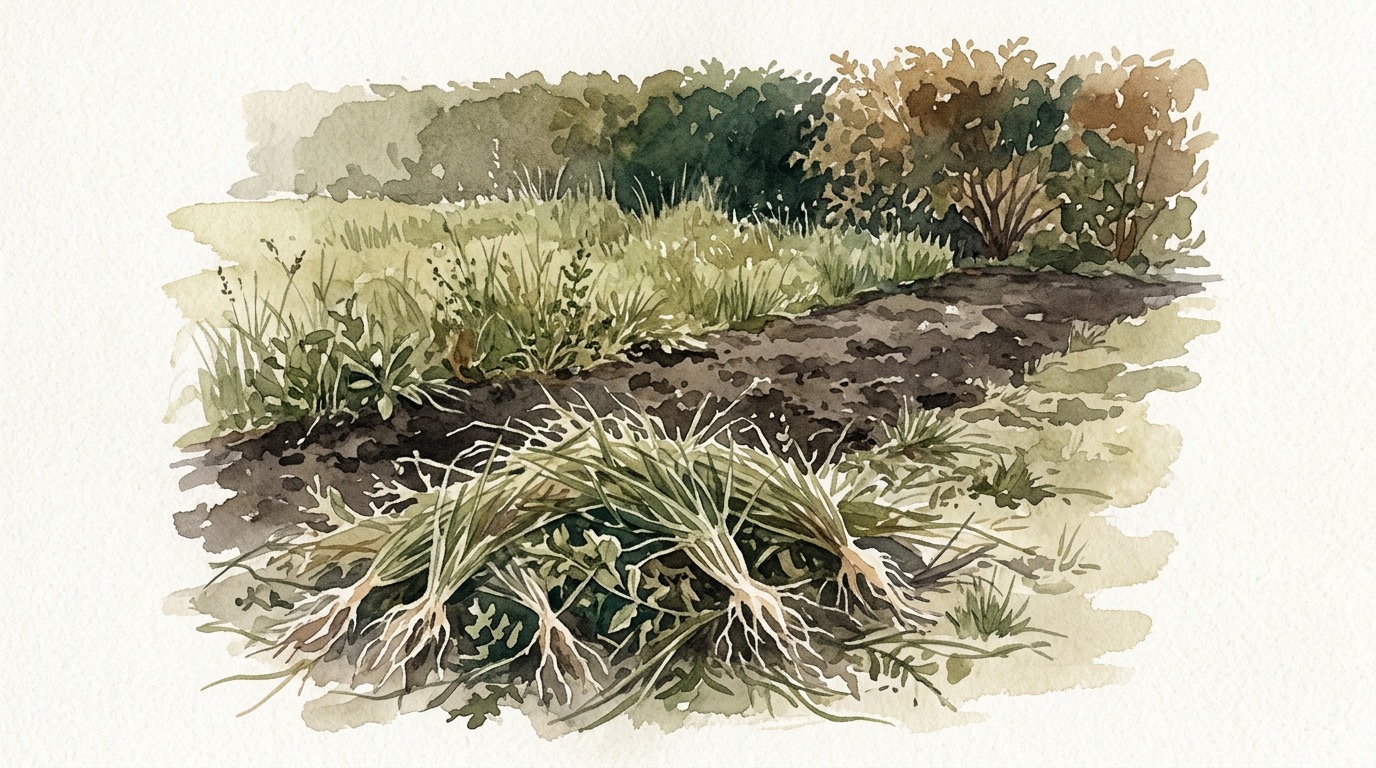
Sometimes you want to start growing now. Covering ground works, and it is efficient and close to effortless — but it is slow. Lifting the turf gets you a bed you can sow carrots into this month. It is more work in one go and less waiting afterwards, and for one small bed that is often the better trade.
The whole skill is in taking off as little as you can get away with. Turf is grass, roots and crowns sitting on the best soil you own, and the mistake almost everyone makes the first time is carrying that soil away with the grass.
When to choose it
- You want to sow root crops — carrots, parsnips, beetroot — which need real depth this season rather than next.
- The area is small. One bed is an afternoon. Four beds is a fortnight, and you will stop.
- The ground is genuinely rough — brambles, nettles, established couch — where a covering of cardboard will lose.
- You want to see what you have. Lifting turf tells you at once whether you are on sand, clay or something in between, and how deep the dark layer goes.
What is not a reason to choose it: having no compost. Clearing needs less compost on the day than covering does, and exactly as much afterwards. Both routes end with compost going on the bed — see below.
What you need
- A spade, sharpened. A half-moon edging iron makes the cutting easier if you have one, but a spade does it all.
- A broadfork, or a stout digging fork if you have not got one.
- A watering can or hose, for the day before.
- Compost, 3–5 cm over the finished bed at minimum.
- Somewhere to compost the turf, out of the way, for a year.
Lifting the turf
Water the day before if the ground is dry. Dry turf tears; damp turf lifts in slabs.
Mark the edges of the bed first — a line of string, or a spade cut all the way round — so you are working to a shape rather than outwards from the middle.
Cut the turf into strips a spade's width across, then slice under each strip shallowly: 4 to 5 cm, no more. That is where almost all the damage happens. Take 15 cm and you have carried your topsoil to the compost heap along with the grass. You want the roots and the crowns, not the soil they are sitting in. Keep the spade almost flat and let it run just under the mat of roots; you will feel when it is too deep, because it gets suddenly heavy.
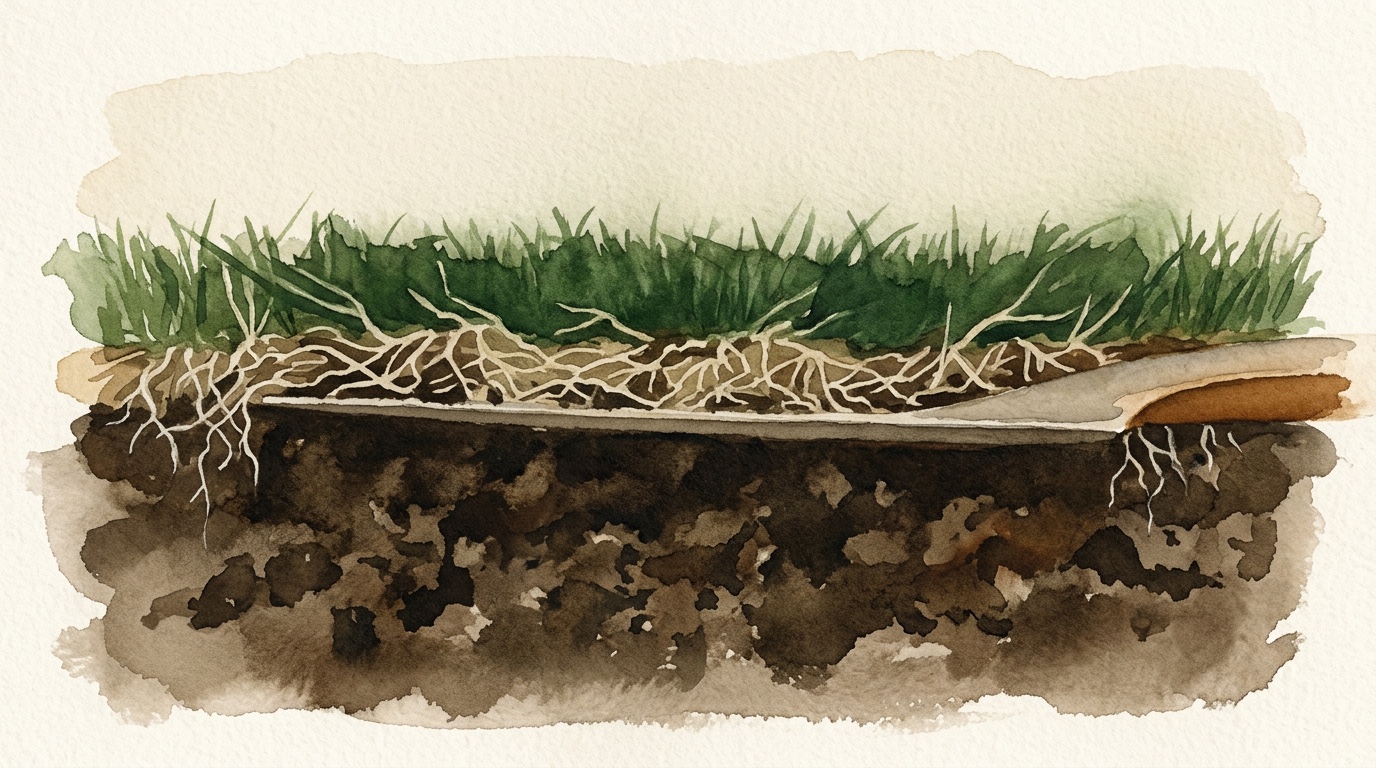
Lift each strip, knock the loose soil off the back of it against the spade, and stack the turf grass side down somewhere it can be forgotten. Stack it a metre or so high and cover it if you like. In a year it is loam, and a better loam than most things you can buy. And the ground under the stack comes out clear and weed-free — a bed for next year, made while you were not looking.
Loosening what is underneath
Do not turn it over. Under the turf is a soil with layers, worm channels and fungal threads in it, and inverting it undoes years of work in an afternoon. The job now is to open that soil without rearranging it.
The tool for it is a broadfork — grelinette in French, bredgrep in Swedish. It is a wide fork with two long handles and a row of tines, typically five at about 25 cm long across a working width of around 45 cm. You use it standing up, which is why it exists: nothing about it involves bending or lifting soil.
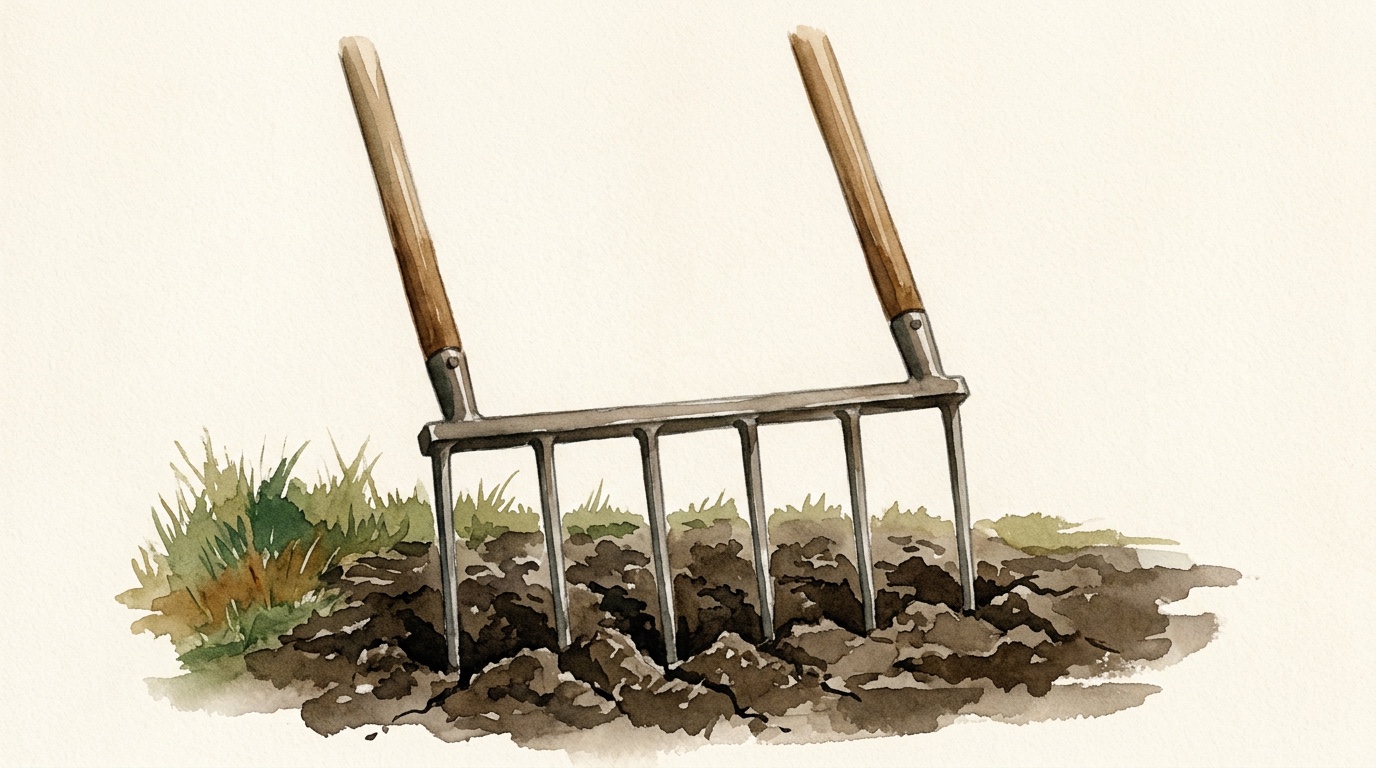
Working backwards across the bed:
- Stand the tines on the soil and step onto the crossbar, letting your weight push them in.
- Rock the handles back towards you until you feel the ground lift and crack. Do not lever it out and turn it over — you are opening the soil, not moving it.
- Ease the tines free, step back 15 to 20 cm, and do it again.
You should end with a bed that looks almost untouched and feels completely different underfoot. Unlike a rotavator, a broadfork does not pulverise the structure or bring a fresh layer of weed seed up to the light where it can germinate. The same tool is what you will reach for later for lifting potatoes and mixing compost into a tired bed.
It is a hand tool, and honest about it: for a very large area of heavily compacted clay it is slow enough that covering starts to look wise again.
Then the compost, always
Spread compost over the finished bed, 3 to 5 cm at minimum and more if you have it, and leave it for the worms to take down. Do not dig it in.
This part is not optional and is not a finishing touch. You have just removed a layer of living material from the ground, and the compost is what replaces it. A bed cleared and left bare loses structure over a winter; a bed cleared and topped is better in the spring than it was in the autumn. If you have no compost supply, start a heap the same week you start the bed.
What comes back
Some of it will. Every fragment of couch or bindweed root left behind is a new plant, and you will not get them all. Go over the bed once a week for the first month and pull what appears while it is small; each pull costs the root a little more than the last.
If a corner keeps coming back — and there is usually one — that corner is a candidate for the other method. Cardboard over it for a season is not an admission of defeat, it is the right tool for the ground that beat the spade.
The honest comparison
Clearing gets you planting sooner and disturbs the soil more. Covering leaves the soil alone and asks you to wait. Neither is the right answer everywhere, and most gardens end up doing some of each — the near bed cleared, the far corner under cardboard until next year.